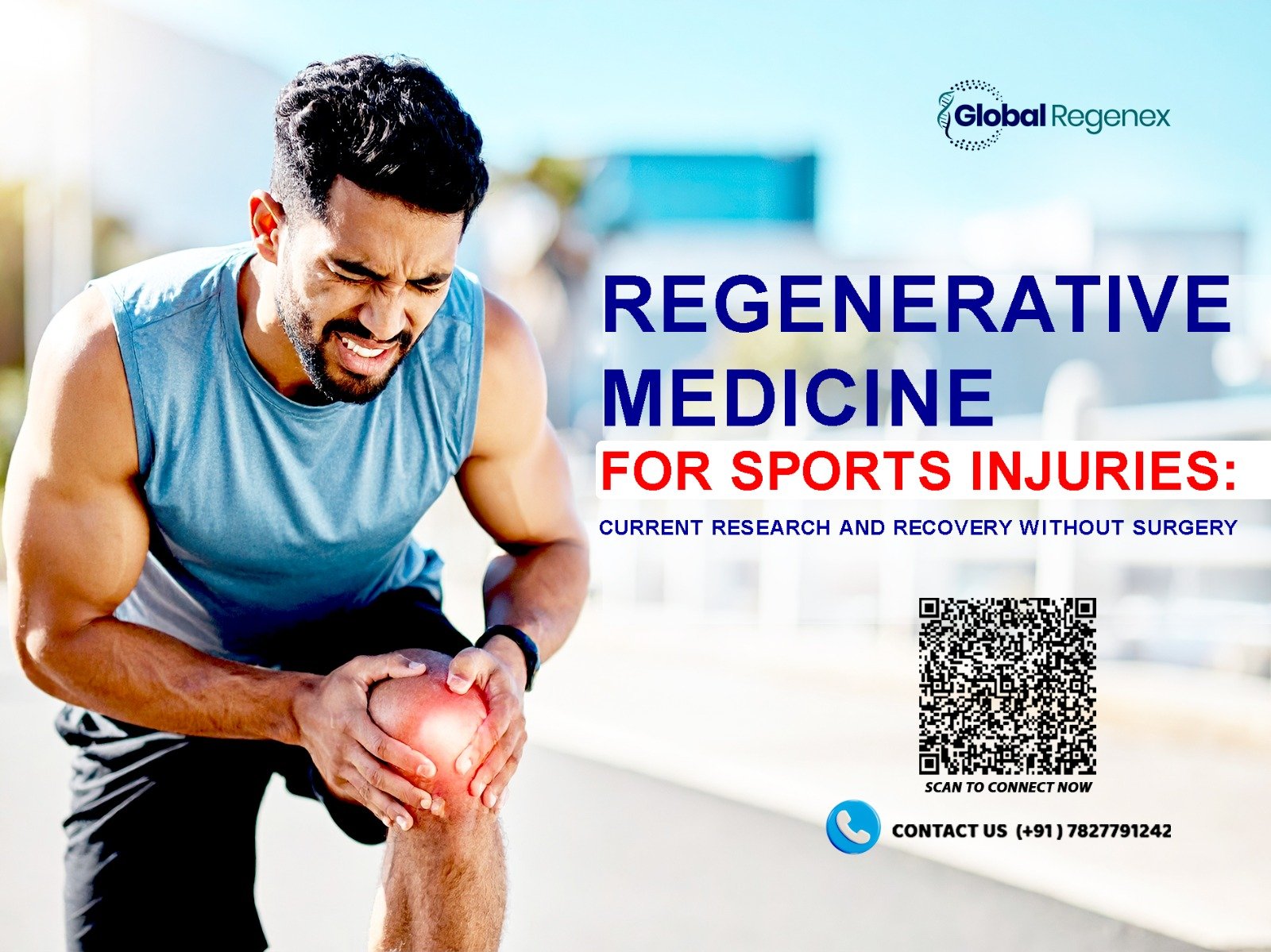
Regenerative medicine is currently being studied as a non-surgical approach for some sports injuries, including tendons, ligaments, cartilage, and muscles. Current research suggests that therapies such as platelet-rich plasma (PRP) and mesenchymal stem cell (MSC) therapy may support the body’s natural healing process. Although stem cell therapy remains investigational for many musculoskeletal injuries, outcomes may vary depending on the type of injury, severity, and personalised patient factors. A complete medical evaluation is important before determining whether regenerative medicine may be the right approach for the overall treatment plan.
Key Takeaways
- Regenerative medicine is being researched as a non-surgical approach for certain sports injuries, particularly those affecting tendons, ligaments, cartilage, and muscles.
- Platelet-rich plasma (PRP) and mesenchymal stem cell (MSC) therapy are among the regenerative treatments currently being studied for their potential role in supporting tissue repair and recovery.
- Current evidence suggests that treatment outcomes vary based on the type of injury, its severity, the patient’s overall health, and the rehabilitation plan followed after treatment.
- Not all sports injuries are suitable for regenerative therapies, making accurate diagnosis and careful patient selection important before considering these options.
- Except for approved hematopoietic stem cell transplantation (HSCT) applications, most stem cell therapies in India remain investigational and are permitted only within regulated clinical research settings under applicable guidelines.
- While research continues to expand, regenerative medicine should be viewed as one part of a comprehensive treatment strategy that may also include physiotherapy, rehabilitation, and lifestyle modifications.
Medically Reviewed By
Written By – Nishat Arfin
Scientific Review By – Tabish Iqbal
Medically Approved By – Global Regenex Medical Team
Last Reviewed: July 2026
Regenerative Medicine for Sports Injuries: Current Research and Recovery Without Surgery
When a patient experiences a pulled hamstring, torn ACL, or an inflamed Achilles, these injuries often mean months on the sidelines, and in some cases, discussions about surgery. While surgery may be necessary for some injuries, other conditions can be managed through rehabilitation, medication, or other newer approaches that may support the body’s natural healing process. This growing interest has brought scientists to research regenerative medicine for sports injuries.
Scientists have recently been investigating regenerative treatments like PRP and MSCs for their potential use in aiding the regeneration of damaged tendons, ligaments, cartilage, and muscles. While initial results are promising in some cases, more is yet to be discovered, and treatment options will depend on the nature and severity of the injury.
As far as regenerative medicine is concerned, much is still yet to be discovered in the stem cell arena. It is thus important to know how present studies view it, which patients will benefit from it, and how these procedures should be viewed in combination with traditional medical treatment.
Why Is Regenerative Medicine Gaining Attention for Sports Injuries?
Sports injuries can affect anyone, from professional sportsmen to people who enjoy regular physical activity. While several injuries respond well to rest, physiotherapy, or medication, some still cause pain or limit movement for long after the expected recovery period. These situations sometimes lead patients to seek alternatives that may support healing without surgery.
Several factors can make sports injuries slower to heal, including:
- Low blood supply to the tendon and cartilage tissues
- Repeated stress due to resumption of exercise before full recovery
- Extreme tearing of the ligaments and muscles
- Individuals’ age and healing capabilities
Due to these issues, these challenges have encouraged ongoing research into regenerative medicine as a possible way to support healing alongside conventional treatment. This therapy is not intended to substitute the existing ones but rather to find their place within the current practice.
What Does Current Research Say About Regenerative Medicine for Sports Injuries?
Research in regenerative medicine has grown over the years, while current studies focus on injuries that are slow to heal or do not respond well to conventional treatment. Although findings differ across different conditions, researchers continue to study whether these therapies may be used in clinical practice.
Current areas of research include:
- Pain and Functional Recovery: Studies are being conducted to determine whether regenerative medicine techniques are able to aid in the reduction of pain, while simultaneously increasing joint function, mobility, and performance.
- Return to Sport: Research is currently taking place to determine whether regenerative techniques can safely be used to enable a quicker return to physical activity and competitive sports.
- Patient Population: Researchers are trying to find out whether certain patients, types of injuries, and states of healing will benefit from regenerative therapies.
- Long-Term Follow-Up: Long-term safety, efficacy, and effectiveness of regenerative medicine treatments are still being assessed through further clinical trials.
Although there have been some promising results in many studies, large-scale clinical trials will be required before regenerative therapy becomes part of the standard treatment regimen for sports injuries.
Which Sports Injuries Are Being Studied with Regenerative Medicine?
Regenerative medicine is still being investigated for several areas of sports medicine, current research focuses mainly on injuries that are difficult to treat or manage through traditional treatments only.
These conditions often include tissues with limited healing capacity or a higher risk of long-term recovery.
Tendon Injuries: Tendinopathies of the Achilles tendon, tennis elbow, golfer’s elbow, and rotator cuff are some of the most researched injuries since the tendon tissue is slow to heal.
Ligament Injuries: The use of regenerative treatments in certain ligament injuries such as partial tears of the ACL and MCL is currently being researched.
Cartilage Injuries: Injuries of the knee and ankle cartilages are still under research due to the low regenerative capacity of cartilage tissues.
Muscle Injuries: Chronic strains of muscles and other soft tissue injuries are under consideration in terms of their possible regeneration.
Research continues to evolve across these injuries, but the strength of evidence differs between conditions. This is why treatment recommendations should always be based on the specific injury rather than assuming the same approach is suitable for every patient.
Who May Be a Suitable Candidate for Regenerative Medicine?
Regenerative medicine is not considered an appropriate approach for every patient with a sports injury. Before suggesting any regenerative approach, healthcare providers evaluate several factors to understand whether it may be a suitable approach as part of a patient’s overall treatment plan.
When assessing suitability, doctors typically consider:
Nature of the Injury: The type, location, and severity of the injury play an important role in deciding whether regenerative therapies may be considered.
Response to Traditional Therapy: Patients who still have symptoms after being provided with traditional rehabilitation, physiotherapy, or any other conservative therapy may need further examination.
General Health: Overall health, pre-existing diseases, and personal characteristics may impact healing and planning of therapy.
Treatment Objectives: Whether you want to get back to competitive sports, engage in some recreational activities, or just move around normally will help determine the treatment.
A full clinical evaluation and examination with necessary imaging techniques are very important before the use of regenerative medicine. The best treatment program should be selected individually according to your disease, current medical data, and recommendations of your physician.
Benefits, Limitations, and What Patients Should Expect
The field of regenerative medicine is increasingly gaining attention due to its capacity to facilitate healing in certain types of sports injuries. However, just like any new field of medicine, there are both advantages and disadvantages associated with regenerative medicine. Being aware of these will assist patients in setting reasonable expectations.
| Potential Benefits Being Studied | Current Limitations |
| It may support the body’s natural healing in specific areas. | Stem cell therapy remains investigational for several sports injuries. |
| May reduce pain and improve joint or muscle function in some patients. | Clinical evidence varies depending on the injury and treatment approach. |
| May complement physiotherapy and rehabilitation as part of a broader recovery plan. | Not every patient or injury is considered suitable for regenerative therapies. |
| May offer a non-surgical option for carefully selected cases where appropriate. | Recovery still requires structured rehabilitation, and results cannot be guaranteed. |
Recovery following any sports injury depends on several factors, including the type of injury, overall health, rehabilitation, and individual healing response. Rather than viewing regenerative medicine as a standalone solution, it should be considered as one component of a broader treatment and recovery plan developed with qualified healthcare professionals.
Looking Ahead
Research into regenerative medicine continues to expand, offering new insights into how certain sports injuries may be managed in the future. While these therapies show promise in selected cases, treatment decisions should always be guided by current evidence, a thorough clinical assessment, and realistic recovery goals. Understanding both the potential and the limitations of regenerative medicine helps patients make informed decisions about their care.
Frequently Asked Questions
Q1. Can regenerative medicine replace surgery for all sports injuries?
No. Surgery remains the most appropriate treatment for many severe injuries, such as complete ligament tears or complex fractures. Regenerative medicine is being studied as a potential option for selected conditions and should only be considered after a thorough medical evaluation.
Q2. How long does recovery usually take after regenerative therapy?
Recovery timelines vary depending on the type of injury, the treatment used, and the individual’s healing response. Many patients also require physiotherapy and a structured rehabilitation programme to achieve the best possible outcome.
Q3. Can PRP and stem cell therapy be used for the same sports injury?
Yes, in some cases both therapies are being studied for similar sports injuries. The most appropriate option depends on the type of injury, individual patient factors, and current clinical evidence.
Q4. Is physiotherapy still necessary if regenerative medicine is used?
Yes. Physiotherapy remains an important part of recovery for most sports injuries. Regenerative therapies, where appropriate, are generally considered alongside rehabilitation rather than as a replacement for it.
Q5. How do doctors decide whether regenerative medicine is appropriate?
Doctors consider several factors, including the diagnosis, severity of the injury, medical history, imaging findings, previous treatments, and the patient’s recovery goals, before recommending any treatment approach.
Reference Links
Bussinelli L, et al.
Platelet-rich plasma for sports-related muscle, tendon and ligament injuries: An umbrella review. Blood Transfusion. 2019.
Available at: https://pmc.ncbi.nlm.nih.gov/articles/PMC6917536/
Sheikhbahaei E, et al.
A Systematic Review and Meta-analysis of the Application of Platelet-Rich Plasma in Sports Medicine. Electronic Physician. 2017.
Available at: https://pmc.ncbi.nlm.nih.gov/articles/PMC4930250/
Daley GQ, Hyun I, Apperley JF, et al.
Setting Global Standards for Stem Cell Research and Clinical Translation: 2021 ISSCR Guidelines. Stem Cell Reports. 2021.
Available at: https://pmc.ncbi.nlm.nih.gov/articles/PMC8190668/
Indian Council of Medical Research (ICMR) & Department of Biotechnology (DBT).
National Guidelines for Stem Cell Research. 2017.
Available at: https://main.icmr.nic.in/sites/default/files/guidelines/Guidelines_for_Stem_Cell_Research_2017.pdf
Jochum M, et al.
Platelet-Rich Plasma in Acute Muscle Injuries: An Umbrella Review and Meta-analysis of Return to Sport and Reinjury Outcomes. The American Journal of Sports Medicine. 2025.
Available at: https://pmc.ncbi.nlm.nih.gov/articles/PMC12966554/
Medical Disclaimer: This blog is intended for educational purposes only and should not be considered medical advice, diagnosis, or treatment. Regenerative medicine for sports injuries should always be evaluated based on an individual’s diagnosis, injury severity, overall health, and current clinical evidence. Except for approved hematopoietic stem cell transplantation (HSCT), most stem cell-based regenerative therapies remain investigational. Always consult a qualified healthcare professional before making decisions about your treatment or recovery plan.
Categories
- Alpastic Anemia
- Amyotrophic Lateral Sclerosis
- Articles
- Autoimmune Disease
- Autoimmune Disorders
- Autologous
- Autologous Stem Cell Transplant
- Blog
- blogs
- Bone Marrow
- Bone Marrow Transplants
- Brain Injury
- Cancer Immunotherapy
- Diabetes
- Diabetic
- Exosome Therapy
- Exosomes
- Eye Damage
- Glaucoma
- Hearing Loss
- Immunotherapy
- Joint Replacement
- Kidney
- Knee Injuries
- Lung Cancer
- Lymphoma
- Orthopedic
- Osteoarthritis
- Pancreatic
- Parkinson’s Disease
- PRP
- PRP Treatment
- Regenerate
- Regenerative Medicine
- Spinal Cord
- Stem Cell Therapy
- Stem Cell Therapy for Eye
- Stem Cell Transplants
- Stem cell treatment
- Stem Cell Treatment Patient Stories
- Stroke
- Supplements
- Tourism