
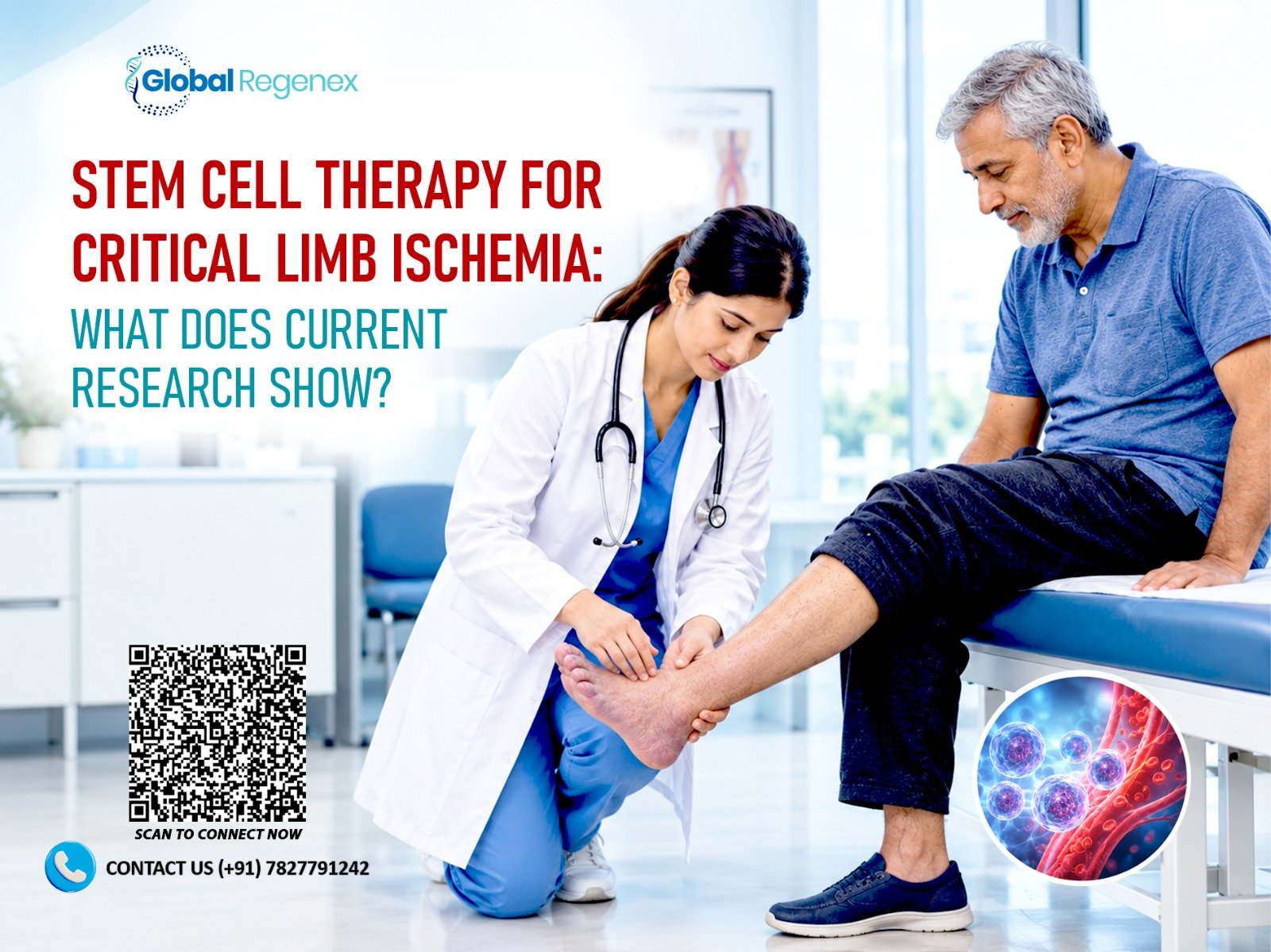
Yes. Stem cell therapy is a promising experimental and regenerative medicine for critical limb ischemia, especially by influencing blood-vessel growth and improving blood flow to ischemic tissue. However, current clinical research has produced mixed results, and its ability to prevent amputation or improve long-term results has not been established. It still remains an investigational approach rather than an established treatment for critical limb ischemia.
Key Takeaways
- Critical limb ischemia is a severe form of peripheral artery disease that can lead to rest pain, non-healing wounds, tissue loss, and limb-threatening complications.
- Stem cell therapy is being studied for its potential to improve blood flow and support tissue repair in areas affected by poor circulation.
- Research has reported possible improvements in blood flow, pain, and wound healing, but clinical findings remain inconsistent.
- Current evidence does not establish stem cell therapy as a replacement for established treatments such as appropriate revascularisation.
- Larger and better-controlled clinical trials are needed to determine its long-term effectiveness, safety, and potential role in preventing limb loss.
Stem Cell Therapy for Critical Limb Ischemia: What Does Current Research Show?
Patients with critical limb ischemia, they often suffer from reduced blood flow to their legs that can become a serious threat to tissue health and limb function over time. Constant pain, non-healing wounds, and tissue damage may occur when affected tissue does not receive enough oxygen and nutrients.
When traditional methods cannot help restore blood flow, researchers are investigating stem cell therapy for critical limb ischemia as a potential regenerative approach. The goal is to understand whether certain cell-based therapies can improve circulation, support wound healing, and potentially lessen the risk of limb loss.
Nevertheless, successful biological mechanisms do not guarantee clinically proven treatment options. The present research has brought controversial results. Therefore, it is crucial for patients to know what researchers have discovered, the kinds of cells that have been investigated, and what still remains uncertain.
What Is Critical Limb Ischemia and Why Is It So Serious?
Critical limb ischemia (CLI), most commonly referred to as chronic limb-threatening ischemia, is a form of peripheral artery disease that reduces blood flow in the limb. Without enough circulation, tissues may not receive adequate oxygen to remain healthy or heal properly.
Common signs and complications include:
- Persistent pain in the foot or leg, particularly at rest
- Non-healing wounds or ulcers
- Tissue loss or gangrene
- Increased risk of limb loss in advanced cases
Doctors assess blood flow and evaluate the condition through physical examination and vascular testing. Revascularisation continues to be one of the most vital therapies in cases where it can be done, whereas stem cell therapy is under investigation as a therapy.
Which Types of Stem Cells Are Being Studied for Critical Limb Ischemia?
Stem cell therapy, however, does not refer to a standard treatment. Researchers are still investigating several types of cells for critical limb ischemia, with differences in their biological characteristics, preparation, and method of delivery.
Some of the main cell types being studied include:
- Bone Marrow-Derived Cells: This type of cell contains different cell populations that may release signals involved in blood-vessel development and tissue repair.
- CD34+ Cells: These cells are being investigated for their potential role in vascular repair and new blood-vessel growth.
- Mesenchymal Stem Cells: Continually explored for their impact on angiogenesis, inflammation, and tissue repair by secretion of signalling molecules.
- Cells Derived from Peripheral Blood: These can be isolated from circulating blood and include populations that are currently under investigation for their possible role in vasculature.
- Adipose-Derived Cells: Isolated from adipose tissue and being examined for their ability to secrete molecules involved in blood vessel development and tissue repair.
Such approaches cannot be considered the same. Different types of cells have been used in various studies using different doses and delivery methods. Therefore, it has been difficult to establish which type of cell is better.
What Potential Benefits Could Stem Cell Therapy Offer Patients With Critical Limb Ischemia?
As research continues to develop, the potential benefits of stem cell therapy for critical limb ischemia are often related to improving blood supply and supporting the health of damaged tissues. Scientists are studying whether cell-based therapies can produce meaningful improvements in symptoms and limb outcomes.
Studies have investigated potential benefits such as:
- Improved Blood Flow: These cell-based therapies may support the growth or function of small blood vessels in ischemic tissue.
- Reduced Rest Pain: Better tissue perfusion may help reduce pain associated with inadequate blood supply.
- Wound Healing: Improved circulation supports healing of ulcers and other ischemic wounds.
- Reduced Risk of Amputation: Researchers are investigating whether better tissue perfusion can ultimately reduce major limb loss.
- Improved Quality of Life: Changes in pain, mobility, wound status, and limb function may affect overall quality of life.
Nevertheless, these are currently the potential benefits and should be considered cautiously. Improvements in blood-flow measurements, pain, or wound healing do not necessarily mean that stem cell therapy may help in avoiding potential amputation or improve long-term survival. Current clinical evidence remains inconsistent and has not been established as reliable outcomes.
How Does Stem Cell Therapy Potentially Help Treat Ischemia?
Stem cell-based approaches are being investigated for certain cells that may help the body develop or improve small blood vessels in areas where blood flow is decreased significantly. Researchers believe the cells may also help release substances that support blood vessel function, reduce inflammation in the area, and create a better environment for damaged tissue to heal.
The proposed effects include:
- Encouraging New Blood Vessels: Some cells have the potential to release signals that may help form new small blood vessels in areas with poor circulation.
- Improving Existing Blood Flow: Stem cell-based therapy may support the development or growth of new blood vessels and pathways that can deliver blood to affected tissues.
- Supporting Tissue Repair: Some cells may release substances involved in healing and tissue recovery.
- Influencing Inflammation: Some cell types may help regulate inflammation within damaged tissues.
However, such effects only justify the need for clinical studies on stem cell treatment in patients with critical limb ischemia because they do not guarantee any improvement in a patient’s condition. It is necessary to conduct further investigations in order to find out if these biological effects have any positive outcomes such as improved healing or pain relief.
What Do Clinical Trials Show About Stem Cell Therapy for Critical Limb Ischemia?
Some clinical trials have demonstrated various results. While some early studies have reported improvements in blood flow, pain, or wound healing, these findings have not been consistently confirmed in larger and well-controlled trials.
Scientists have found it difficult to compare results, as studies have used different cell types, doses, treatment methods, and patient groups.
Most importantly, a consistent reduction in the need for amputation or improvement in long-term limb outcomes has not been established. Current evidence supports continued research, but stem cell-based therapy is not yet used as standard treatment in clinical practice.
What Are the Risks and Limitations of Stem Cell Therapy for Critical Limb Ischemia?
Stem cell-based therapy for critical limb ischemia remains investigational, so both its potential benefits and long-term safety are still being investigated.
- Risks may include pain, bleeding, infections, or other problems caused by cell harvesting or injection.
- Investigational procedures use different kinds of cells and delivery methods, making comparisons of results hard to make.
- The long-term effects of some investigational cell products are not entirely known.
- Stem cell therapy should not prevent vascular therapy that is considered standard treatment.
- Patients should verify the treatment’s regulatory status and understand whether it is being offered as part of a properly conducted clinical trial.
Looking Ahead
In recent times, stem cell therapy has offered a potential regenerative approach for critical limb ischemia, but research has not yet established whether it can reliably preserve the limb or improve long-term results. Future studies need to determine which cell types, treatment methods, and patients are more likely to benefit.
In the meantime, patients need to be wary of this therapy. A comprehensive vascular assessment and review of existing treatment choices would be required before undertaking any form of treatment. At this point, Global Regenex can assist patients in learning about the relevant information, weighing the evidence, and discussing it with their healthcare team before making an informed decision.
Frequently Asked Questions
Q1. Is stem cell therapy approved for critical limb ischemia?
Stem cell therapy is not currently an established standard treatment for critical limb ischemia. Its regulatory status depends on the specific cell product, treatment, and country where it is offered.
Q2. Who may be eligible for stem cell therapy clinical trials?
Eligibility depends on the individual study. Trials may consider factors such as the severity of limb ischemia, whether conventional treatments are suitable, previous vascular procedures, and the patient’s overall health.
Q3. How long does stem cell therapy take to work for critical limb ischemia?
There is no established timeframe. Research studies use different treatment protocols and follow patients for different periods, so the timing and extent of any improvement can vary.
Q4. How is stem cell therapy for critical limb ischemia administered?
Depending on the treatment being studied, cells may be injected directly into muscles of the affected limb or delivered through a blood vessel. The most effective delivery method has not yet been established.
Q5. What should I ask before considering stem cell therapy for critical limb ischemia?
Patients can ask which cells are being used, whether the treatment is part of a registered clinical trial, what evidence supports it, what risks are known, what alternatives are available, and how follow-up care will be provided.
Reference Links
(1) Conte, M. S., et al. (2019). Global Vascular Guidelines on the Management of Chronic Limb-Threatening Ischemia. European Journal of Vascular and Endovascular Surgery. Retrieved from:
https://pubmed.ncbi.nlm.nih.gov/31159978/
(2) Liew, A., Bhattacharya, V., Shaw, J., & Stansby, G. (2016). Cell Therapy for Critical Limb Ischemia: A Meta-Analysis of Randomised Controlled Trials. Angiology. Retrieved from:
https://pubmed.ncbi.nlm.nih.gov/26195561/
(3) Kawamoto, A., et al. (2009). Intramuscular transplantation of G-CSF-mobilized CD34(+) cells in patients with critical limb ischemia: A phase I/IIa, multicenter, single-blinded, dose-escalation clinical trial. Stem Cells. Retrieved from:
https://pubmed.ncbi.nlm.nih.gov/19711453/
(4) Powell, R. J., et al. (2012). Cellular therapy with Ixmyelocel-T to treat critical limb ischemia: The randomised, double-blind, placebo-controlled RESTORE-CLI trial. Molecular Therapy. Retrieved from:
https://pubmed.ncbi.nlm.nih.gov/22453769/
(5) Bianchi, C., et al. (2017). Autologous Bone Marrow Mononuclear Cell Implantation and Its Impact on the Outcome of Patients With Critical Limb Ischemia: Results of a Randomised, Double-Blind, Placebo-Controlled Trial. Circulation Journal. Retrieved from:
https://pubmed.ncbi.nlm.nih.gov/28603176/
Medical Disclaimer
This blog is intended for educational purposes only and does not constitute medical advice or provide a diagnosis. Individual circumstances vary, and treatment suitability can only be determined through an appropriate medical assessment. Patients should consult a qualified healthcare professional before making decisions about stem cell therapy or any other treatment.
Categories
- Alpastic Anemia
- Amyotrophic Lateral Sclerosis
- Articles
- Autoimmune Disease
- Autoimmune Disorders
- Autologous
- Autologous Stem Cell Transplant
- Blog
- blogs
- Bone Marrow
- Bone Marrow Transplants
- Brain Injury
- Cancer Immunotherapy
- Diabetes
- Diabetic
- Exosome Therapy
- Exosomes
- Eye Damage
- Glaucoma
- Hearing Loss
- Immunotherapy
- Joint Replacement
- Kidney
- Knee Injuries
- Lung Cancer
- Lymphoma
- Orthopedic
- Osteoarthritis
- Pancreatic
- Parkinson’s Disease
- PRP
- PRP Treatment
- Regenerate
- Regenerative Medicine
- Spinal Cord
- Stem Cell Therapy
- Stem Cell Therapy for Eye
- Stem Cell Transplants
- Stem cell treatment
- Stem Cell Treatment Patient Stories
- Stroke
- Supplements
- Tourism