
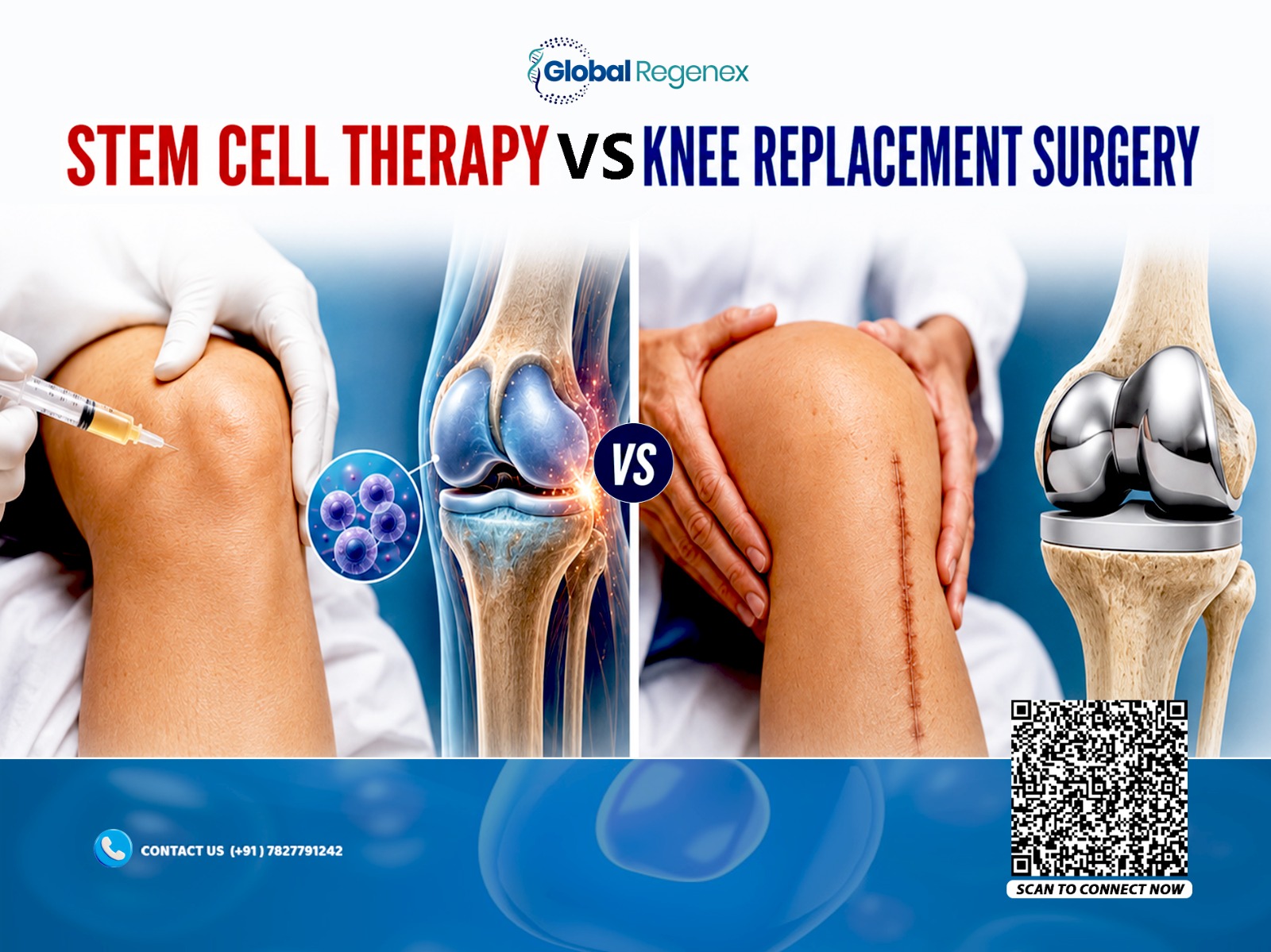
Stem Cell Therapy and Knee Replacement Surgery are two methods that can be used to treat different kinds of knee ailments based on the patient’s diagnosis and symptoms, among other considerations. Stem cell therapy is an emerging area of regenerative medicine research, whereas knee replacement surgery is an established orthopedic procedure for selected patients with severe joint damage. Having a clear idea of the differences between these methods could assist patients in making well-informed decisions about their options during consultations with medical practitioners.
Key Takeaways
- Stem cell therapy and knee replacement surgery differ in their purpose, treatment approach, and current clinical use.
- Knee replacement surgery is an established treatment option for selected patients with severe knee joint damage.
- Stem cell therapy continues to be studied for its potential role in regenerative medicine and knee-related research.
- The available scientific evidence varies depending on the treatment approach and the patient’s condition.
- Treatment decisions should consider the severity of the knee condition, overall health, and professional medical advice.
- Patients are encouraged to discuss the potential benefits, risks, and available treatment options with qualified healthcare professionals.
Medically Reviewed By
Written By – Nishat Arfin
Scientific Review By Tabish Iqbal
Medically Approved By – Global Regenex Medical Team
Last Reviewed: June 2026
Stem Cell Therapy vs Knee Replacement Surgery
Suffering from persistent knee pain can affect a person’s mobility, daily activities, and overall quality of life. While the symptoms progress, many individuals start to explore different treatment approaches and often compare emerging cell-based therapies with well-established surgical procedures.
However, sometimes stem cell therapy and knee replacement surgery are discussed together, but they are fundamentally different in their objectives, approaches, and current clinical use. While knee replacement surgery has an established role in managing certain orthopedic conditions, stem cell therapy remains under investigation through ongoing clinical research for various regenerative medicine applications.
This blog highlights the differences between stem cell therapy and knee replacement surgery, presents the scientific findings in this regard, and discusses the issues that need to be considered by patients during consultation with their health care providers.
How Is Stem Cell Therapy Being Studied for Knee Conditions?
In recent years, stem cell therapy has attracted the interest of patients as well as researchers to explore new approaches for managing knee-related conditions, especially those involving joint tissue and cartilage. Instead of replacing traditional treatment approaches for orthopedic procedures, current research is investigating how stem cell-based approaches may contribute to regenerative medicine and to better understand joint health.
Current research continues to evaluate the safety, effectiveness, and long-term outcomes of stem cell-based approaches for different knee conditions. Nevertheless, the evidence that is currently available depends on several factors, including the medical condition being considered, the specific kind of stem cells, and the course of treatment.
Knowing about the current state of stem cell therapy is important when comparing it with more conventional methods, such as knee surgery.
When Is Knee Replacement Surgery Typically Considered?
Knee replacement surgery is typically considered for the patient when there is knee joint damage or when symptoms such as persistent pain, stiffness, and reduced mobility continue to affect daily activities, despite other suitable non-surgical management. The decision to undergo surgery is often based on a comprehensive clinical evaluation rather than a single symptom or imaging result.
Many different factors can be considered by healthcare professionals before advising knee replacement surgery, such as:
Joint Damage Severity: This is determined through clinical and imaging assessments, which evaluate the extent of cartilage loss, changes to the joints, and overall function of the knee.
Impact on Daily Activities: Difficulties walking, climbing stairs, or completing regular activities may factor into the development of treatment plans.
Response to Previous Treatment: Whether previous treatments using medication, physical therapy, lifestyle changes, or other conservative interventions have been effective or not is usually considered.
Overall Patient Health: Age, medical history, health problems, and overall eligibility for surgery play a role in the clinical assessment process.
Patient Objectives and Expectations: Lifestyle, activity level, and individual objectives also play a role in the decision-making process for patients and practitioners.
Given that every patient is unique, the recommendation to undergo knee replacement surgery will depend on an individual assessment by an orthopedist.
Stem Cell Therapy vs Knee Replacement Surgery
Though stem cell therapy and knee replacement surgery may appear in the same discussion, they are completely different in objective, level of evidence, and clinical application. The following comparison provides a general overview of how these approaches differ.
| Feature | Stem Cell Therapy | Knee Replacement Surgery |
| Main Approach | Investigated in regenerative medicine to better understand tissue-related processes and joint health. | An established surgical approach that replaces damaged parts of the knee joint with artificial components. |
| Current Clinical Status | Some applications have been established, while others remain under clinical investigation. | Widely performed in clinical settings for appropriate knee joint damage. |
| Treatment Goal | Research focuses on understanding regenerative approaches and their potential role in patient care. | Aims to relieve pain and improve joint function by replacing damaged joint surfaces. |
| Scientific Evidence | The level of evidence varies based on condition, stem cell type, and treatment protocol. | Supported by established clinical guidelines and long-term evidence for appropriate patient populations. |
| Patient Eligibility | Suitability depends on the medical condition, available evidence, and professional evaluation. | It is determined through orthopaedic assessment, imaging findings, symptom severity, and overall health. |
| Recovery Considerations | Recovery and follow-up requirements vary depending on the specific treatment approach being studied. | Recovery generally involves rehabilitation, physical therapy, and regular follow-up after surgery. |
It is advisable to review both approaches within the context of individual medical condition, treatment objectives, and available evidence. Patients are encouraged to discuss all the options with a qualified healthcare professional before making any decision.
Can Stem Cell Therapy Replace Knee Replacement Surgery?
Many patients wonder if stem cell therapy will ever be able to replace knee replacement surgery. The answer depends on several clinical factors, including the underlying knee condition, the extent of joint damage, and the available scientific evidence.
Stem cell therapy and knee replacement surgery do not qualify as interchangeable approaches for all patients. Knee replacement surgery is a well-known method of treatment for selected patients with severe knee joint damage, while stem cell therapy is an approach that is still under investigation in many areas of regenerative medicine.
Each person’s condition is unique, therefore, treatment should be chosen based on the full medical analysis and consultations with healthcare specialists.
How Do Recovery and Rehabilitation Differ?
Whether patients decide to take stem cell therapy or knee replacement surgery, recovery remains an important part of the treatment plan and can vary depending on the approach selected, the patient’s health status, and the nature of the underlying knee condition. Patients are encouraged to discuss expected recovery timelines and rehabilitation needs with their healthcare professional before making a treatment decision.
Some general differences include:
- Recovery Period: Knee replacement surgery often requires a recovery period. Stem cell-based therapy may require a recovery timelines vary depending on the treatment approach, the patient’s overall health, and the underlying knee condition.
- Physical Therapy: Physical therapy is a common practice for patients who have undergone knee replacement surgery, as it helps restore their mobility and functions. Stem cell-based therapy may require different rehabilitation requirements depending on the treatment approach and individual patient needs.
- Follow-up Treatment: Follow-up treatment is an important way through which the medical practitioner can monitor the patient’s progress and provide any adjustments needed.
- Return to Daily Activities: The return of the patient to his daily activities may take varying lengths of time depending on the chosen treatment modality.
As the recovery process varies from one individual to another, patients should consider discussing expectations about rehabilitation with their medical practitioners before choosing any treatment approach.
Looking Ahead
Stem cell therapy and knee replacement surgery represent different approaches to managing knee conditions, both with their potential role within modern healthcare. Instead of seeing one as a replacement for another, it is advisable to understand how they differ, the level of evidence supporting each approach, and the factors that may influence treatment decisions.
For those seeking treatment options, consulting with qualified healthcare professionals will enable patients to have a better understanding of the options at hand and to select one that suits their own particular situation.
Frequently Asked Questions
Q1. Is stem cell therapy suitable for everyone with knee pain?
No. It depends on several factors, including the particular cause of knee problems, the extent of the symptoms, general health, and present-day knowledge. Clinical evaluation will help to choose the right treatment modality.
Q2. Is knee replacement surgery always the first treatment option?
No. Knee replacement is usually performed after a thorough clinical evaluation if the symptoms are not relieved by other treatment modalities.
Q3. Can stem cell therapy delay the need for knee replacement surgery?
Researchers continue to investigate whether stem cell-based approaches may play a role in managing certain knee conditions. The available evidence varies, and treatment decisions should always be based on clinical evaluation and current scientific evidence.
Q4. How do healthcare professionals decide which treatment is appropriate?
Several factors influence this decision, such as the diagnosis, the degree of joint damage, medical history, imaging results, treatment objectives, and existing scientific data on its effectiveness.
Q5. Why is a professional medical evaluation important before choosing a treatment?
A comprehensive medical assessment helps determine the nature of the knee condition, discusses available treatment options, and ensures decisions are based on individual healthcare needs and current clinical evidence.
Reference Links
American Academy of Orthopaedic Surgeons (AAOS). Total Knee Replacement. Available at:
https://orthoinfo.aaos.org/en/treatment/total-knee-replacement/
U.S. Food and Drug Administration (FDA). Important Patient and Consumer Information About Regenerative Medicine Therapies. Available at:
Harvard Stem Cell Institute. What Stem Cell-Based Therapies Are Currently Available? Available at:
https://www.hsci.harvard.edu/faq/stem-cell-therapies
Migliorini F, et al. Stem Cell Injections for Knee Osteoarthritis: A Systematic Review of Randomized Clinical Trials. Available at:
https://pmc.ncbi.nlm.nih.gov/articles/PMC10390179/
National Institute of Arthritis and Musculoskeletal and Skin Diseases (NIAMS). Joint Replacement Surgery. Available at:
https://www.niams.nih.gov/health-topics/joint-replacement-surgery
Bauer SR, et al. Stem Cell-based Products in Medicine: FDA Regulatory Considerations. Available at:
https://pmc.ncbi.nlm.nih.gov/articles/PMC7149600/
Medical Disclaimer
This blog is intended for educational purposes only and should not be considered medical advice. The suitability of stem cell therapy or knee replacement surgery depends on the individual’s medical condition, available scientific evidence, and clinical evaluation. Patients should consult qualified healthcare professionals before making treatment decisions.
Categories
- Alpastic Anemia
- Amyotrophic Lateral Sclerosis
- Articles
- Autoimmune Disease
- Autoimmune Disorders
- Autologous
- Autologous Stem Cell Transplant
- Blog
- blogs
- Bone Marrow
- Bone Marrow Transplants
- Brain Injury
- Cancer Immunotherapy
- Diabetes
- Diabetic
- Exosome Therapy
- Exosomes
- Eye Damage
- Glaucoma
- Hearing Loss
- Immunotherapy
- Joint Replacement
- Kidney
- Knee Injuries
- Lung Cancer
- Lymphoma
- Orthopedic
- Osteoarthritis
- Pancreatic
- Parkinson’s Disease
- PRP
- PRP Treatment
- Regenerate
- Regenerative Medicine
- Spinal Cord
- Stem Cell Therapy
- Stem Cell Therapy for Eye
- Stem Cell Transplants
- Stem cell treatment
- Stem Cell Treatment Patient Stories
- Stroke
- Supplements
- Tourism