
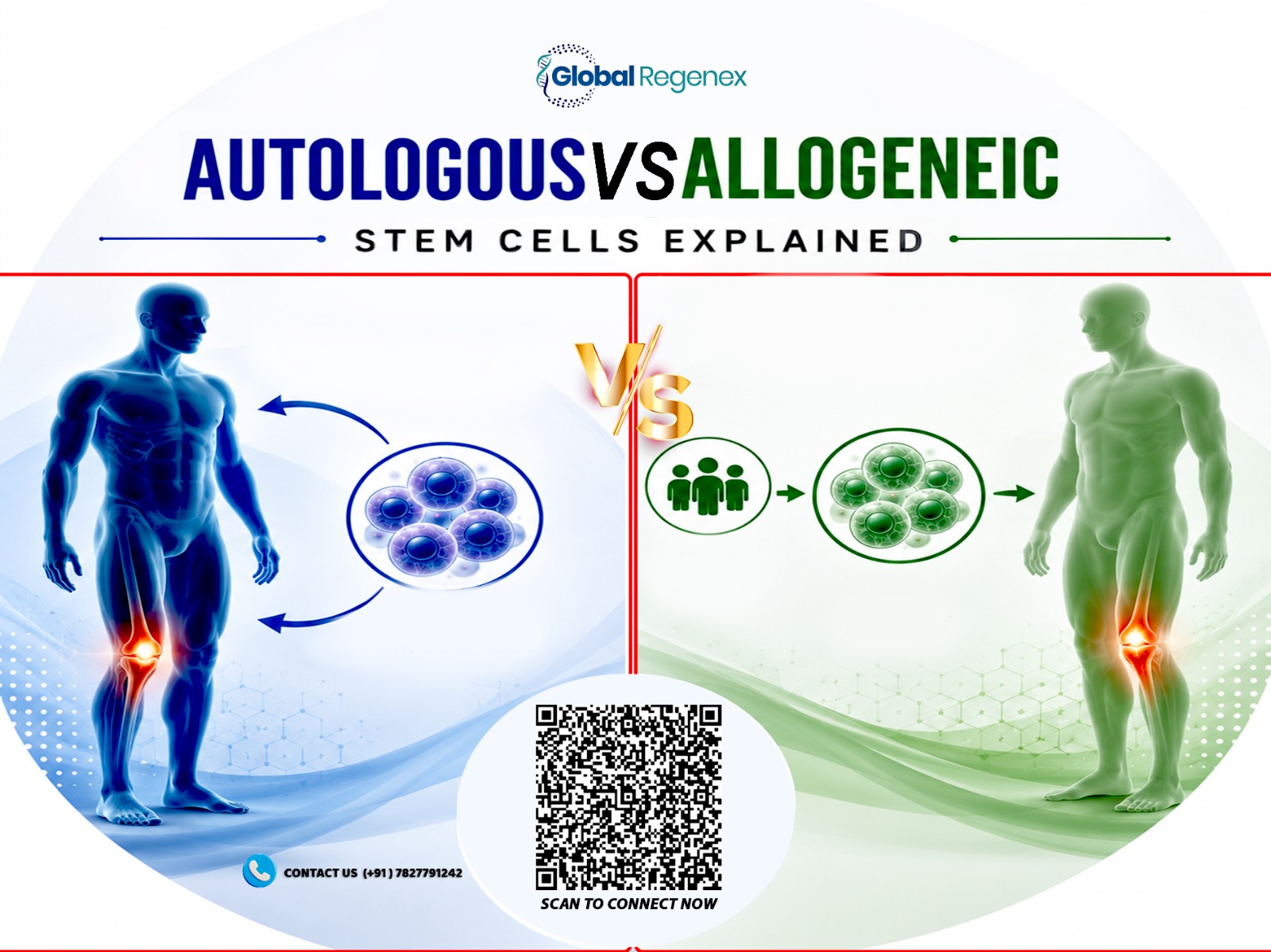
Autologous and allogenic stem cells are different primarily in how they are obtained. Autologous stem cells are collected from the patient’s own body, whereas allogenic stem cells are obtained from a suitable or matched donor. Both approaches are widely studied across regenerative medicine and clinical research. Their suitability depends on factors such as the medical condition, treatment goals, and the available scientific evidence. Understanding these differences can help patients discuss stem cell-based therapies with qualified healthcare professionals
Key Takeaways
- Autologous stem cells are obtained from the patient’s own body.
- Allogeneic stem cells are collected from a suitable donor.
- Both approaches are being studied across different areas of regenerative medicine.
- The source of stem cells may influence treatment planning and research design.
- Healthcare professionals evaluate multiple clinical factors before considering stem cell-based approaches.
- Many stem cell applications continue to be investigated through ongoing scientific and clinical research.
Medically Reviewed By
Written By – Nishat Arfin
Scientific Review By Tabish Iqbal
Medically Approved By – Global Regenex Medical Team
Last Reviewed: June 2026
Autologous vs Allogeneic Stem Cells Explained
Stem cell research has introduced different approaches that vary in how stem cells are collected and used in clinical research and regenerative medicine. Among the most frequently used and discussed are autologous and allogenic stem cells. Although both involve stem cells, but they differ in their source, collection process, and the considerations involved in healthcare research.
As regenerative medicine continues to evolve, patients are likely to come across these terminologies when researching treatment possibilities or stem cell research. It is important to understand the difference between autologous and allogeneic stem cells because it can help one understand information better and engage with health care providers knowledgeably.
This blog discusses the difference between these two types of stem cells and what is known about them in terms of research and factors affecting their use in regenerative medicine research.
How Are Autologous Stem Cells Obtained?
Autologous stem cells are collected from the same individual who is expected to undertake the stem cell-based treatment or participate in clinical trials. As the cells originate in the patient’s own body. Researchers continue to study autologous stem cells across various areas of regenerative medicine and clinical research.
As they are derived from the patient, depending on treatment protocols and the patient’s medical condition, healthcare professionals may collect stem cells from different sources, such as bone marrow, peripheral blood, and adipose tissue within the body. Also, the collection process may vary from patient to patient based on the type of stem cell being studied and used in clinical practices.
Some of the common features of autologous stem cells are:
- Patient Source: These stem cells come from the patient undergoing the therapy.
- Individualized Collection Process: This process of collecting stem cells is customized based on the health of the patient and the treatment procedure.
- Research Application: Research is being conducted in many areas regarding the usage of these stem cells.
- Consideration for Clinical Use: It should be determined whether it is suitable to use these stem cells based on many considerations, such as the health of the patient and the therapeutic goal.
By understanding how autologous stem cells are extracted, we can lay the groundwork for comparing them with the donor’s stem cells.
How Are Allogeneic Stem Cells Obtained?
Unlike autologous stem cells, allogeneic stem cells are obtained from a suitable donor rather than the individual receiving treatment. Before they are used in clinical or research settings, donor cells typically undergo screening and evaluation based on applicable medical protocols and regulatory requirements.
Researchers continue to examine allogeneic stem cells across various areas of regenerative medicine, as they offer a different approach to stem cell-based research compared with patient-derived cells. Their suitability depends on the patient’s medical condition, treatment goals, and level of scientific evidence available.
Some general features of allogeneic stem cells are:
- Source from Donor: Stem cells come from an appropriate donor, but not the individual receiving treatment.
- Screening of Donors: Donors are typically screened through medical procedures in order to ensure that donated stem cells are of good quality.
- Research Applications: Allogeneic stem cells are being researched in various fields of regenerative medicine.
- Clinical Considerations: Whether donor-derived stem cells will be used or not depends on factors like the state of health of the individual and other clinical considerations.
It is important to understand how allogeneic stem cells are harvested in order to understand why donors are screened differently by researchers and healthcare experts.
Autologous Vs Allogeneic Stem Cells: Key Differences Between Autologous and Allogeneic Stem Cells
Both autologous and allogeneic stem cells hold a promising avenue in regenerative medicine and are widely studied for different medical conditions. But they differ in their source, collection process, and clinical consideration. The following table will provide a general comparison to help understand these two approaches better.
| Feature | Autologous Stem Cells | Allogeneic Stem Cells |
| Cell Source | Collect from the same individual receiving the treatment. | Collected from a suitable donor. |
| Collection Process | Cells are obtained from the patient’s own body following medical evaluation | Cells are collected from screened donors according to established medical protocols. |
| Primary Use in Research | Studied across various regenerative medicine and clinical research applications. | Also investigated across multiple areas of regenerative medicine and healthcare research. |
| Donor Requirement | Does not require a separate donor. | Requires a medically suitable donor. |
| Clinical Consideration | Suitability is dependent upon the patient’s medical condition, therapeutic aims, and clinical evaluation. | Suitability is based upon the suitability of the donor, requirements of the patient, therapeutic objectives, and clinical assessment. |
| Scientific Evidence | Evidence differs based on the medical condition and method of treatment being investigated. | Evidence can also vary based on the medical condition and stem cell source under investigation. |
Both stem cell types are still being studied in various fields of regenerative medicine. The decision regarding which approach to use, autologous stem cells or allogeneic stem cells, is determined by each case, its goals, and existing scientific facts.
Is One Stem Cell Source Better Than the Other?
Autologous and allogeneic stem cells both have unique properties, which is why they continue to evolve and are studied across different areas of regenerative medicine. Instead of a single source being considered universally better than the other, healthcare professionals and researchers evaluate which approach may be more appropriate based on the patient specific conditon, treatment objective, and available evidence.
Among the elements that affect the assessment process are:
Medical Condition: The condition being studied or treated may influence which stem cell source is considered during the clinical planning.
Treatment Objective: Several research and clinical protocols may need different stem cell sources depending on the intended purpose.
Patient-Based Factors: Age, state of health, medical history, and personal health care needs are significant issues in planning the treatment.
Scientific Evidence: Scientific evidence differs according to the stem cell source and the application in healthcare. Therefore, the need to evaluate the evidence scientifically becomes important.
Professional Medical Assessment: Professionals take into account several clinical issues before deciding on whether a certain stem cell source is applicable to the patient.
As the science of regenerative medicine keeps developing, it is better not to rely solely on assumptions but rather consult scientific sources and healthcare specialists when making a decision.
Looking Ahead
Autologous and allogeneic stem cells offer immense possibilities and play an important role in regenerative medicine research. While they can differ in source and clinical considerations, both continue to be investigated to better understand their potential applications in different healthcare settings.
Instead of determining whether one source of stem cells is “better” than another, it may be more useful to recognize the fact that what might be the most suitable approach varies according to a number of different factors, including the individual’s medical history, goals of treatment, and available scientific data.
Frequently Asked Questions
Q1. What factors determine whether autologous or allogeneic stem cells are used?
It depends on several factors, such as medical condition, treatment goal, clinical evaluation, and evidence available, to determine whether autologous or allogeneic stem cells are appropriate for an individual’s medical condition.
Q2. Are autologous and allogeneic stem cells used in regenerative medicine research?
Yes, autologous and allogeneic stem cells are actively investigated in the field of regenerative medicine research. Scientists keep studying their properties, possible applications, and effects in various healthcare institutions.
Q3. Do autologous and allogeneic stem cells come from the same source?
No, autologous stem cells are extracted from the body of a patient who undergoes the procedure, while allogeneic stem cells are extracted from an appropriate donor after a medical evaluation.
Q4. Why do researchers study different stem cell sources?
Various sources of stem cells have unique biological attributes that might suit specific areas of scientific investigation. Scientific research helps to increase knowledge on its possible application in the medical field.
Q5. Where can patients learn more about different stem cell approaches?
Patients should look for information from healthcare professionals and credible medical sources. It is essential to understand the existing scientific evidence to make a decision in healthcare.
Reference Links
Khaddour K, et al. Hematopoietic Stem Cell Transplantation. StatPearls Publishing. Updated 2023.
https://www.ncbi.nlm.nih.gov/books/NBK536951/
Henig I, Zuckerman T. Hematopoietic Stem Cell Transplantation—50 Years of Evolution and Future Perspectives. Rambam Maimonides Medical Journal. 2014.
https://pmc.ncbi.nlm.nih.gov/articles/PMC4222417/
Léger CS, et al. Hematopoietic Stem Cell Transplantation: A Primer for Primary Care. Canadian Medical Association Journal.
https://pmc.ncbi.nlm.nih.gov/articles/PMC400723/
Riezzo I, et al. Donor Selection for Allogeneic Hematopoietic Stem Cell Transplantation.
https://pmc.ncbi.nlm.nih.gov/articles/PMC5478865/
Nagieva S, et al. Allogeneic Hematopoietic Stem Cell Transplantation as Personalized Medicine. 2025.
https://pmc.ncbi.nlm.nih.gov/articles/PMC12730341/
European Blood and Marrow Transplantation (EBMT). HSCT: How Does It Work?
https://www.ncbi.nlm.nih.gov/books/NBK543664/
Medical Disclaimer
The content mentioned in this blog is for educational purposes only and should not be regarded as medical advice. The utilization of autologous and allogeneic stem cells varies according to the health condition of the patient, the goals of treatment, and regulations. Although some stem cell treatments have been proven clinically effective for certain conditions, many other applications in regenerative medicine are still under study.
Categories
- Alpastic Anemia
- Amyotrophic Lateral Sclerosis
- Articles
- Autoimmune Disease
- Autoimmune Disorders
- Autologous
- Autologous Stem Cell Transplant
- Blog
- blogs
- Bone Marrow
- Bone Marrow Transplants
- Brain Injury
- Cancer Immunotherapy
- Diabetes
- Diabetic
- Exosome Therapy
- Exosomes
- Eye Damage
- Glaucoma
- Hearing Loss
- Immunotherapy
- Joint Replacement
- Kidney
- Knee Injuries
- Lung Cancer
- Lymphoma
- Orthopedic
- Osteoarthritis
- Pancreatic
- Parkinson’s Disease
- PRP
- PRP Treatment
- Regenerate
- Regenerative Medicine
- Spinal Cord
- Stem Cell Therapy
- Stem Cell Therapy for Eye
- Stem Cell Transplants
- Stem cell treatment
- Stem Cell Treatment Patient Stories
- Stroke
- Supplements
- Tourism